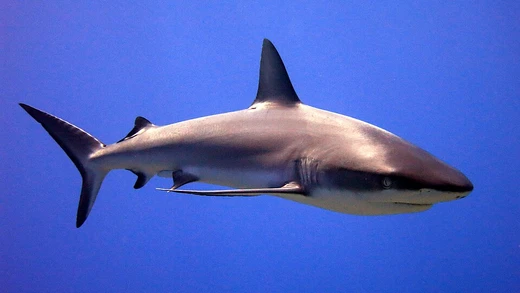
Blacktip reef shark
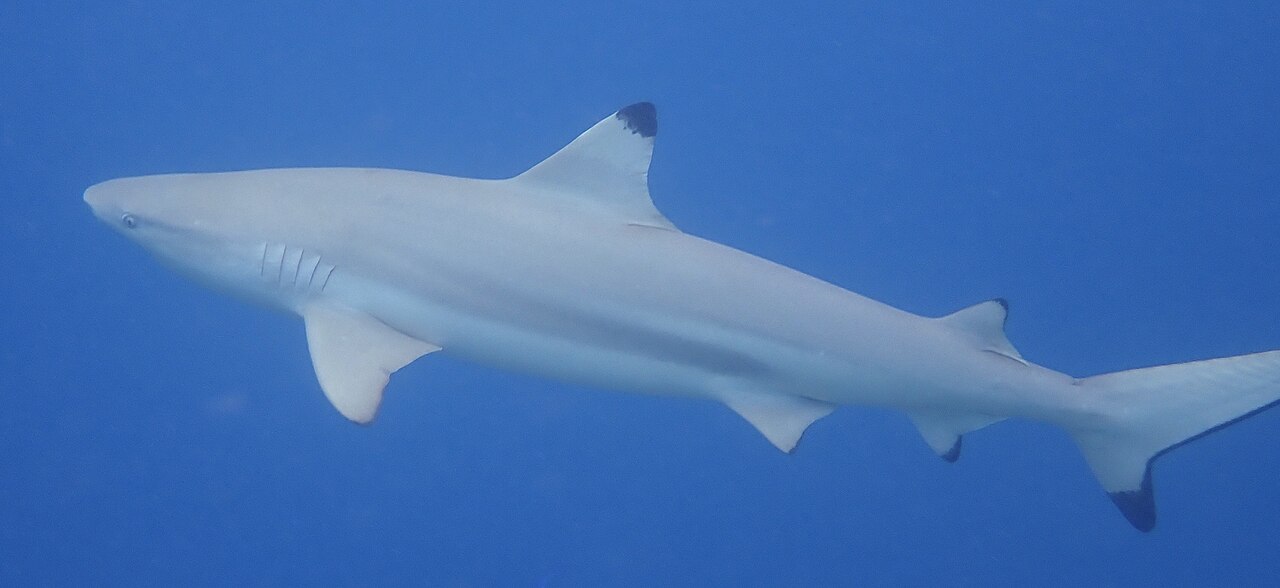
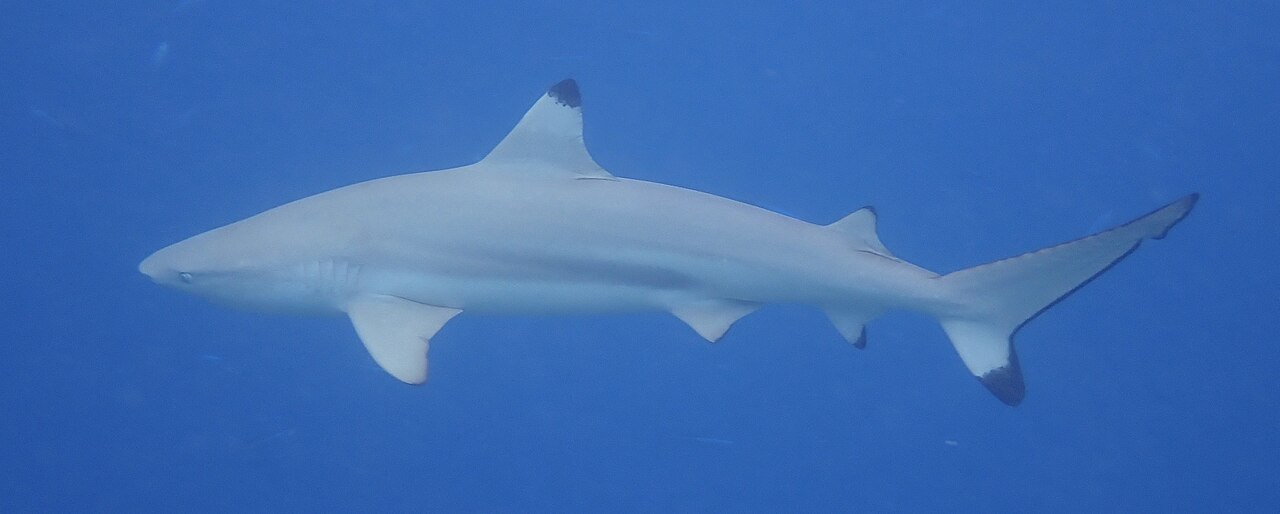
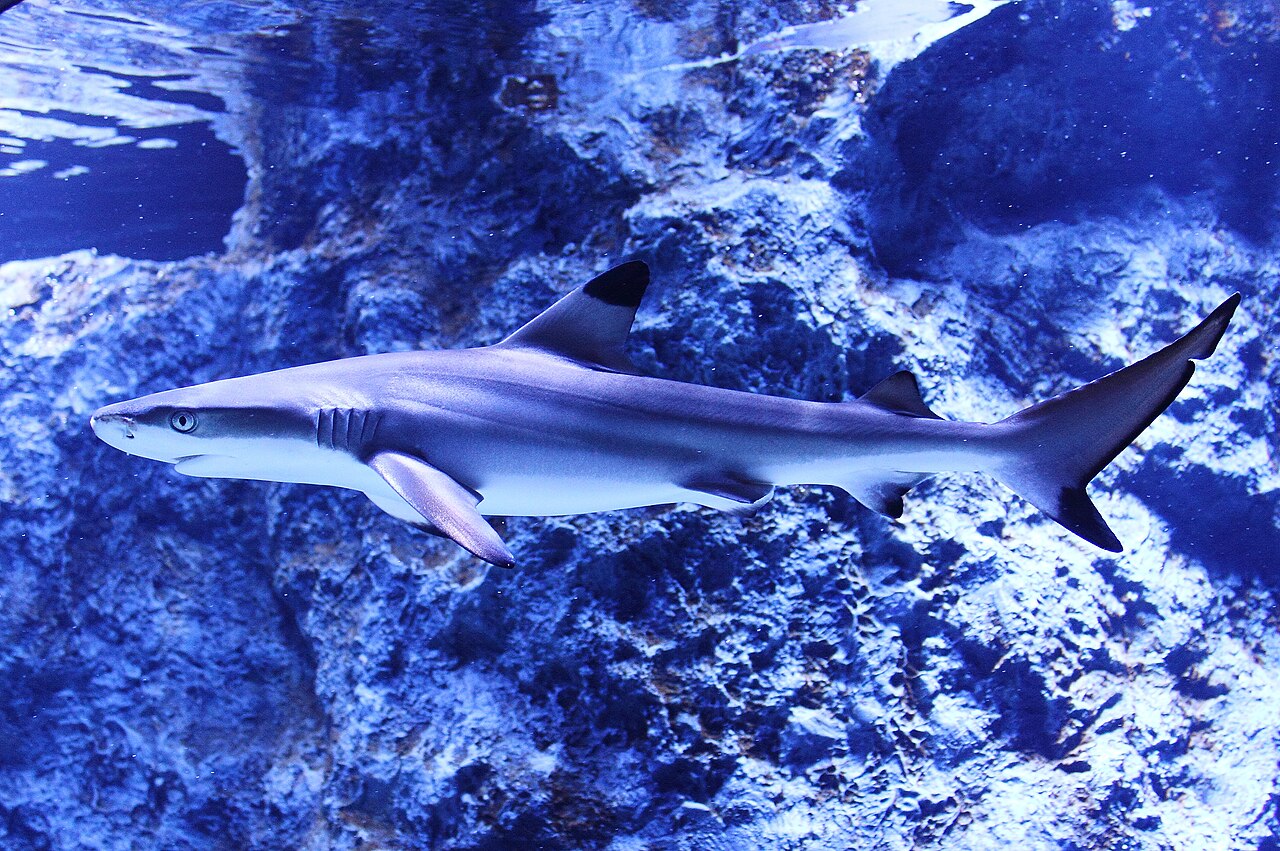
A common, timid reef shark with black-tipped fins.

Kakidai · CC BY-SA 3.0
The blacktip reef shark (Carcharhinus melanopterus) is a species of requiem shark in the family Carcharhinidae, easily identified by the prominent black tips on its fins, especially the first dorsal and caudal fins. It is among the most abundant sharks inhabiting tropical coral reefs of the Indian and Pacific Oceans, preferring shallow, inshore waters, and its exposed first dorsal fin is a common sight in the region.
- Scientific name
- Carcharhinus melanopterus
- Typical length
- 1.6 m (5.2 ft)
- Maximum weight
- 13.6 kg (30 lb)
- Conservation status
- Vulnerable (IUCN)
- Gestation period
- 7–9, 10–11, or possibly 16 months (reports vary)
- Litter size
- 2 to 5 young
Lore & Background
l'Uranie et la Physicienne. The type specimen was a 59 cm juvenile male caught off Waigeo, west of New Guinea. They named it Carcharias melanopterus, from Greek melas meaning 'black' and pteron meaning 'fin' or 'wing'. The blacktip reef shark has extremely small home ranges and exhibits strong site fidelity, remaining within the same local area for up to several years. It is an active predator of small bony fish, cephalopods, and crustaceans, and has also been known to feed on sea snakes and seabirds. Like other members of its family, it is viviparous, with females giving birth to two to five young on a biennial, annual, or possibly biannual cycle. Reports of the gestation period range from 7–9, through 10–11, to possibly 16 months. Newborn sharks are found further inshore and in shallower water than adults, frequently roaming in large groups over areas flooded by high tide.
Reader's Guide
The blacktip reef shark is one of the three most common sharks inhabiting coral reefs in the Indo-Pacific, along with the grey reef shark and the whitetip reef shark. It predominates in shallow habitats, while the other two are mostly found deeper. Timid and skittish, it is difficult to approach and seldom poses a danger to humans unless roused by food, though people wading through shallow water are at risk of having their legs mistakenly bitten. This shark is used for its meat, fins, and liver oil, but is not considered commercially significant. The International Union for Conservation of Nature has assessed it as Vulnerable; although the species remains widespread and relatively common, overfishing of this slow-reproducing shark has led to its decline at a number of locales. A tracking study off Palmyra Atoll found its home range is around 0.55 km², among the smallest of any shark species. The blacktip reef shark has also colonized the eastern Mediterranean Sea as a Lessepsian migrant via the Suez Canal.
Did You Know?
- The blacktip reef shark's scientific name Carcharhinus melanopterus comes from Greek melas meaning 'black' and pteron meaning 'fin' or 'wing'.
- It has one of the smallest home ranges of any shark species, around 0.55 km², based on a tracking study off Palmyra Atoll.
- Reports of its gestation period vary widely, from 7–9 months to 10–11 months, and possibly up to 16 months.
- It is a Lessepsian migrant that has colonized the eastern Mediterranean Sea via the Suez Canal.
Origins of a Name: Discovery and Taxonomy
The original type specimen was a juvenile male measuring just 59 centimeters, captured off the island of Waigeo in waters west of New Guinea. Quoy and Gaimard coined the binomial Carcharias melanopterus, drawing on the Greek words melas for "black" and pteron for "fin" or "wing," a direct nod to the species' unmistakable dark-edged fins. The animal has accumulated a colorful array of common names across regions—blackfin reef shark, black-finned shark, reef blacktip shark, and guliman among them—while some older texts erroneously listed it under the name C. spallanzani, a designation now properly belonging to the spottail shark.
A Vast Indo-Pacific Range
The blacktip reef shark commands one of the broadest nearshore distributions of any requiem shark, stretching across tropical and subtropical waters of both the Indian and Pacific Oceans. In the Indian Ocean its range spans from South Africa northward to the Red Sea, encompassing Madagascar, Mauritius, the Seychelles, the shores of the Indian subcontinent, Sri Lanka, the Andaman Islands, and the Maldives. Pacific populations extend from southern China and the Philippines through Indonesia and northern Australia to New Caledonia, and the species has established itself on numerous scattered island chains, including the Marshall, Gilbert, Society, and Hawaiian archipelagos as well as the Tuamotu atolls. Sightings have even been recorded from the inshore waters of Ishigaki Island in southern Japan. Perhaps most remarkably, this shark qualifies as a Lessepsian migrant: it has colonized the eastern Mediterranean Sea by passing through the Suez Canal. While a single record places it at 75 meters depth, the species overwhelmingly inhabits water only a few meters deep, with juveniles favoring sandy flats and adults congregating around reef ledges and drop-offs. In Madagascar and Malaysia it has been observed in brackish estuaries and even freshwater, though it cannot match the bull shark's tolerance for low salinity.
Reproduction and the Rhythms of Reef Life
Reproduction in the blacktip reef shark follows a viviparous pattern, with females delivering litters of two to five pups on a cycle that may be biennial, annual, or even biannual depending on the population studied. Gestation estimates in the literature are notably inconsistent, with reported durations spanning from seven to nine months, through ten to eleven, to as long as sixteen months—discrepancies that researchers attribute in part to geographical variation within the species. Courtship behavior is relatively straightforward: a male shadows the female at close range, presumably drawn by her chemical cues, before mating occurs. Newborns occupy a distinctly different niche from their parents, appearing further inshore and in shallower water, often moving in large groups across tidal flats that are submerged only at high tide. Adults, by contrast, maintain extremely small home ranges and demonstrate remarkable site fidelity, lingering in the same local patch of reef for several consecutive years. Females consistently exceed males in size, and the species typically reaches a maximum length of about 1.6 meters. As an active predator, the blacktip reef shark feeds on small bony fish, cephalopods, and crustaceans, with occasional forays into sea snakes and seabirds.
Conservation Pressures and Human Encounters
Despite its widespread presence across the Indo-Pacific, the blacktip reef shark has been assessed by the International Union for Conservation of Nature as Vulnerable. The species as a whole remains relatively common, yet its slow reproductive rate—small litters delivered on multi-year cycles—makes it particularly susceptible to overfishing, and measurable declines have been documented at numerous localities. Although it is harvested for meat, fins, and liver oil, it does not rank as a commercially significant target in most fisheries. In terms of human interaction, the blacktip reef shark is notably timid and skittish, making it difficult to approach and rarely posing a genuine threat unless provoked by the presence of food. The principal risk to people occurs when waders in shallow water are mistaken for prey, resulting in bites to the legs. Phylogenetically, the species' exact position within Carcharhinus remains unresolved; morphological and allozyme studies from the 1980s and 1990s consistently placed it in an ambiguous cluster with up to ten other genus members, including the nervous shark, without yielding a definitive branching order. This taxonomic uncertainty underscores how much remains to be learned about one of the ocean's most recognizable reef predators.
Common Misconceptions (Editorial)
- A common misconception is that blacktip reef sharks are large, open-ocean predators. In fact, they are relatively small, with a typical length of only 1.6 m (5.2 ft) and a maximum weight of 13.6 kg (30 lb), and they prefer shallow, inshore waters of tropical coral reefs. - Some may assume the species is widespread and abundant enough to be secure, but its conservation status is listed as "Vulnerable (IUCN)," indicating it faces real threats.
Why It Matters (Editorial)
The blacktip reef shark endures as a signature species of tropical coral reefs, its exposed dorsal fin a familiar emblem of healthy shallow waters. Understanding its vulnerability and small home range underscores the importance of protecting specific reef habitats, as even localized threats can have outsized impacts on this species.
Gallery
Frequently Asked Questions
Who is Blacktip reef shark?
The blacktip reef shark (Carcharhinus melanopterus) is a small requiem shark in the Carcharhinidae family, instantly recognizable by the dark tips on its dorsal and tail fins. It typically reaches about 1.6 meters in length and tops out near 13.6 kg in weight.
What is Blacktip reef shark's role in the reef ecosystem?
It functions as a mid-level predator on tropical coral reefs, keeping populations of small reef fish and invertebrates in check. Its naturally timid, often schooling temperament makes it a familiar but generally non-aggressive presence in shallow inshore waters.
Where does Blacktip reef shark live?
It is most commonly encountered in the shallow, inshore waters of coral reefs across the Indian and Pacific Oceans. Its exposed first dorsal fin is one of the most frequently spotted shark silhouettes in those tropical regions.
How does Blacktip reef shark reproduce?
The species is viviparous, producing litters of roughly two to five pups after a gestation period that various sources place anywhere from about seven up to sixteen months. The wide range in reported durations reflects some ongoing uncertainty in the scientific literature.
Why is Blacktip reef shark important and what is its conservation status?
The IUCN currently classifies the species as Vulnerable, a designation driven by coastal development, overfishing, and broader habitat degradation. Because it is one of the most numerically abundant reef sharks in its range, any significant decline serves as a warning sign for the health of the entire coral-reef ecosystem.
More in Sharks 1-22
Spotted an error? Know more?
This is a living reference — every entry is fact-audited, and reader corrections feed straight into our audit queue. Suggest an edit · See this site's audit record