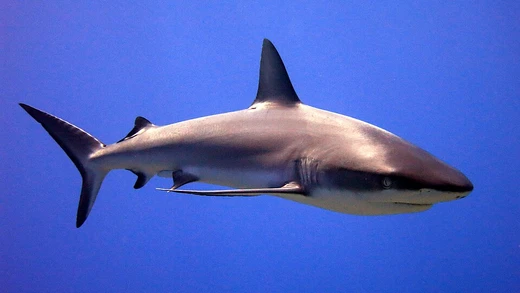
Great hammerhead
Largest hammerhead shark, apex predator, critically endangered by overfishing.

The great hammerhead (Sphyrna mokarran) is the largest species of hammerhead shark, belonging to the family Sphyrnidae. It is a solitary, strong-swimming apex predator found in warmer oceans worldwide, known for its distinctive wide cephalofoil with an almost straight front margin.
- Maximum length
- 6.2 m (20 ft)
- Average length
- 4.6 m (15 ft)
- Litter size
- 2–49 pups every two years
- Reproduction
- Viviparous
Lore & Background
The lectotype is a 2.5 m male from the Red Sea. Phylogenetic analyses using nuclear and mitochondrial DNA have placed the great hammerhead and smooth hammerhead as a basal clade to all other Sphyrna species, refuting earlier views that cephalofoil size gradually increased over evolution. The earliest fossil teeth are known from the Early Miocene of Cuba, with additional fossils from the Middle Miocene to Pliocene of Florida and the Late Miocene of Panama and Brunei.
Reader's Guide
The great hammerhead is significant as the largest hammerhead species and a key apex predator in tropical marine ecosystems. Its distinctive cephalofoil serves multiple functions: it houses electroreceptors for detecting buried stingrays, acts as a hydrofoil for rapid turns, and is used to immobilize prey. The species is heavily targeted for its large fins, which are highly valued in the Chinese market for shark fin soup, driving a global population decline. Despite its size and potential danger, the great hammerhead rarely attacks humans and may behave inquisitively toward divers. Its reproductive strategy—viviparous with litters of up to 49 pups every two years—limits its ability to recover from overfishing. The species' migratory behavior and preference for coastal habitats, including coral reefs and continental shelves, make it vulnerable to fishing pressure across its range. Conservation efforts are critical to prevent further decline of this ecologically important predator.
Did You Know?
- Its cephalofoil is wide with an almost straight front margin, distinguishing it from other hammerheads.
- The species is named from the Arabic 'mokarran,' meaning 'horned.'
- Fossil teeth of the great hammerhead have been found from the Early Miocene of Cuba.
Common Misconceptions (Editorial)
Some people believe the great hammerhead’s cephalofoil is unique among hammerheads for being extremely wide, but the fact-check shows its distinctiveness lies specifically in having an almost straight front margin, not just width. Others may think the species’ name “mokarran” has an obscure or unknown origin, but it is derived from the Arabic word for “horned.”
Why It Matters (Editorial)
The great hammerhead endures as a symbol of the ocean’s apex predators, reminding us that even familiar-looking sharks can conceal extraordinary evolutionary adaptations, like its uniquely shaped cephalofoil. Its ancient lineage, evidenced by Miocene fossils, underscores how long these animals have shaped marine ecosystems—and how urgently their conservation matters in a rapidly changing world.
Frequently Asked Questions
What is the Great hammerhead shark?
The Great hammerhead (Sphyrna mokarran) is the largest member of the hammerhead family, Sphyrnidae, and one of the biggest sharks on Earth. It is a solitary, powerful swimmer that patrols warm ocean waters across the globe.
What makes its head shape unique among sharks?
Its cephalofoil—commonly called the 'hammer'—is exceptionally wide with a nearly straight leading edge, distinguishing it from other hammerhead species. This broad structure houses its eyes and nostrils at the tips, giving it a very wide field of vision and electroreception.
How does the Great hammerhead reproduce?
It is viviparous, meaning pups develop inside the mother and are born live. A single litter can range from 2 to as many as 49 pups, with a new litter produced roughly every two years.
More in Sharks 1-22
Spotted an error? Know more?
This is a living reference — every entry is fact-audited, and reader corrections feed straight into our audit queue. Suggest an edit · See this site's audit record