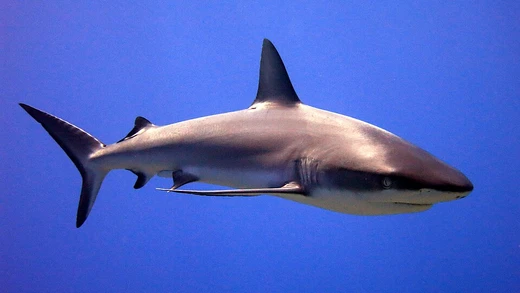
Cookiecutter shark
Small shark that bites round plugs from larger animals.

The cookiecutter shark (Isistius brasiliensis), also called the cigar shark, is a small squaliform shark in the family Dalatiidae. It is known for its distinctive feeding method of gouging round plugs of flesh from larger animals, leaving wounds that resemble cookie-cutter impressions. Despite its small size, it preys on a wide variety of marine life, including animals much larger than itself, and has been recorded at depths up to 3.7 km.
- Scientific name
- Isistius brasiliensis
- Maximum length
- 42 cm (males), 56 cm (females)
- Depth range
- Up to 3.7 km (2.3 mi)
- Diet
- Tuna, swordfish, squid, shellfish, whales, dolphins, orcas, larger sharks, and smaller prey
- Conservation status
- Least Concern (IUCN)
- Notable feature
- Bites round plugs from larger animals using suctorial lips and saw-like lower teeth
Lore & Background
One of the earliest accounts of the wounds left by the cookiecutter shark appears in ancient Samoan legend, which held that skipjack tuna entering Palauli Bay would leave behind pieces of their flesh as a sacrifice to Tautunu, the community chief.
Reader's Guide
The cookiecutter shark is significant for its unique parasitic feeding strategy, which has been observed on a wide range of marine mammals, fishes, submarines, undersea cables, and even human bodies. Its adaptations include a dark collar that mimics the silhouette of a small fish, while photophores on its underside blend into downwelling light, allowing it to lure predators and then attach itself to excise flesh. Though rarely encountered, it is not regarded as dangerous to humans. The International Union for Conservation of Nature lists it as least concern due to its wide distribution, lack of commercial value, and low susceptibility to fisheries. Its ability to migrate vertically up to 3 km daily and its tolerance for low oxygen levels further highlight its ecological role in oceanic ecosystems.
Did You Know?
- The cookiecutter shark migrates vertically up to 3 km (1.9 mi) every day, approaching the surface at dusk and descending with the dawn.
- Its lower teeth are shed in entire rows rather than one at a time, and the shark swallows its old teeth to recycle calcium.
- The species was originally named Scymnus brasiliensis by Quoy and Gaimard after a specimen caught off Brazil.
- Marks made by cookiecutter sharks have been found on submarines, undersea cables, and human bodies.
Common Misconceptions (Editorial)
- Many people assume the cookiecutter shark is large because it attacks whales, dolphins, and even submarines, but it is actually small — males reach only 42 cm and females 56 cm in maximum length. - Some believe its bite is a tear or slash, but the shark’s feeding method is precise: it uses suctorial lips and saw-like lower teeth to gouge out round plugs of flesh, leaving cookie-cutter-shaped wounds. - It is commonly thought that the species was named after its biting behavior, but the scientific name *Isistius brasiliensis* was originally given by Quoy and Gaimard based on a specimen caught off Brazil, long before its feeding habits were fully understood.
Why It Matters (Editorial)
The cookiecutter shark endures in public imagination not because of its size, but because of the shocking contrast between its modest body and its outsized impact on marine giants, from whales to submarines. Its ancient role in Samoan legend underscores how this tiny predator has left a literal mark on human culture for centuries, reminding us that the most fearsome creatures in the ocean are not always the largest.
Frequently Asked Questions
Who is Cookiecutter shark?
The cookiecutter shark (Isistius brasiliensis), sometimes nicknamed the cigar shark, is a small squaliform species in the Dalatiidae family. It's best known across the shark world for its unmistakable habit of carving neat round plugs of tissue out of much larger animals.
What are Cookiecutter shark's powers/role?
Using suction-like lips together with serrated lower teeth, it gouges circular flesh plugs from prey ranging from tuna and squid up to whales, orcas, and bigger sharks. It has been recorded at depths of up to 3.7 km, making it one of the deepest-ranging small predators in the ocean.
How does Cookiecutter shark's story end?
As a living species rather than a single character arc, it has no fixed ending, but its current IUCN status is Least Concern, so global populations aren't in immediate jeopardy. It continues to roam deep and mid-depth waters across the world's oceans.
Why is Cookiecutter shark important?
It provides a striking example of how a tiny predator can leave its mark on the ocean's largest animals, and those telltale round wounds are a key clue for marine biologists identifying deep-sea encounters. Its ability to thrive at nearly 4 km depth also helps researchers understand small-life survival in the deep ocean.
How big is Cookiecutter shark and what does it look like?
Males grow to roughly 42 cm and females to about 56 cm, keeping it firmly in the small-shark category. Its most recognizable feature is the pair of suctorial lips combined with saw-like lower teeth that together produce the signature cookie-cutter bite.
More in Sharks 1-22
Spotted an error? Know more?
This is a living reference — every entry is fact-audited, and reader corrections feed straight into our audit queue. Suggest an edit · See this site's audit record