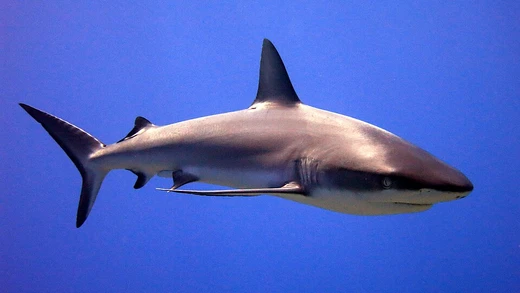
Frilled shark
Living fossil with eel-like body and frilled gill slits.

The frilled shark (Chlamydoselachus anguineus), also known as the lizard shark, is one of the two extant species of shark in the family Chlamydoselachidae. It is considered a living fossil due to its primitive, eel-like physical traits, including a dark-brown color, amphistyly (jaw articulation to the cranium), and a body length of up to 2.0 m (6.6 ft). The common name derives from the fringed appearance of its six pairs of gill slits at the throat.
- Scientific name
- Chlamydoselachus anguineus
- Family
- Chlamydoselachidae
- Maximum body length
- 2.0 m (6.6 ft)
- Gestation period
- Up to 3.5 years
- Litter size
- 2–15 pups
- Diet
- Cephalopods, smaller sharks, bony fish
Lore & Background
The name derives from Greek chlamy (frill) and selachus (shark), and Latin anguineus (like an eel). The frilled shark is considered a living fossil because its family lineage dates to the Carboniferous period. Early scientists debated its evolutionary relationships: Garman linked it to Devonian cladodont sharks, while Theodore Gill and Edward Drinker Cope suggested relation to Mesozoic hybodonts. Modern phylogeny places it in the neoselachian clade, possibly within the order Hexanchiformes, though some propose a separate order, Chlamydoselachiformes. Fossil teeth of C. anguineus date to the early Pleistocene epoch. The two species, C. anguineus and C. africana, are aplacental viviparous: embryos develop in egg capsules inside the mother, then hatch in the uterus and feed on yolk. Gestation can last up to 3.5 years, producing litters of 2–15 pups. The frilled shark is usually caught as bycatch and has some economic value as meat and fishmeal.
Reader's Guide
The frilled shark is significant as a living fossil, retaining primitive traits such as amphistyly, a quasi-cartilaginous notochord, and long jaws with trident-shaped teeth. Its lineage dates to the Carboniferous period, and it has remained relatively unchanged since the Late Jurassic and Late Cretaceous epochs. This makes it a key species for understanding the evolution of modern sharks and rays. The frilled shark practices diel vertical migration, feeding at night near the ocean surface on cephalopods, smaller sharks, and bony fish. Its distribution spans the Atlantic and Pacific oceans, usually near the ocean floor on the outer continental shelf and upper continental slope, favoring biologically productive areas. In Suruga Bay, Japan, it is common at depths of 50–200 m, but moves deeper when water temperatures exceed 15 °C. Reproductively, the frilled shark has a notably long gestation period of up to 3.5 years, one of the longest among sharks. It has no distinct breeding season. The species is often caught as bycatch, and a large capture of over 30 individuals on a Mid-Atlantic Ridge seamount in the late 2000s suggested such seamounts may be mating sites. Its legacy lies in its role as a window into ancient shark lineages and its unique adaptations for deep-sea life.
Did You Know?
- The frilled shark is named for the fringed appearance of its six pairs of gill slits at the throat.
- Its gestation period can be up to 3.5 years, one of the longest known among sharks.
- A large capture of over 30 frilled sharks occurred over a seamount on the Mid-Atlantic Ridge in the late 2000s.
Common Misconceptions (Editorial)
- Some may think the frilled shark is a true eel due to its elongated body, but it is a shark, as confirmed by its classification in the family Chlamydoselachidae and its shark-like traits such as amphistyly and aplacental viviparous reproduction. - It is not accurate to assume the frilled shark is a modern, recently evolved species; the facts show it is considered a living fossil, with its family lineage dating to the Carboniferous period and fossil teeth from the early Pleistocene.
Why It Matters (Editorial)
The frilled shark endures in public interest because it embodies a direct link to prehistoric oceans, surviving for hundreds of millions of years with remarkably primitive traits. Its extraordinary three-and-a-half-year gestation period also challenges common assumptions about reproduction in the animal kingdom, reminding us how much of the deep sea remains mysterious and extraordinary.
Frequently Asked Questions
What is the Frilled shark?
The Frilled shark (Chlamydoselachus anguineus) is a deep-sea member of the family Chlamydoselachidae, often nicknamed the "lizard shark" for its elongated, eel-like body. Its common name comes from the fringed appearance of its six pairs of gill slits along the throat.
Why is the Frilled shark called a living fossil?
It retains primitive anatomical features such as amphistyly, a jaw-to-cranium articulation that most other sharks have lost. Combined with its eel-like silhouette and dark-brown coloration, it looks almost unchanged from ancient ancestors.
How large does the Frilled shark grow?
Adults can reach a maximum body length of about 2.0 meters (roughly 6.6 feet). Despite that measurement, its slender, snake-like build makes it appear far smaller than a typical shark of the same length.
How do Frilled sharks reproduce?
Females carry their young for up to 3.5 years before giving birth to a litter of 2 to 15 pups. This extraordinarily long gestation period is among the slowest reproductive cycles in the shark world.
More in Sharks 1-22
Spotted an error? Know more?
This is a living reference — every entry is fact-audited, and reader corrections feed straight into our audit queue. Suggest an edit · See this site's audit record