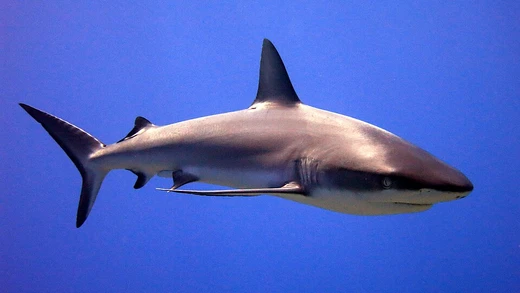
Thresher shark
Large mackerel sharks with a tail as long as the body.

Thresher sharks are large mackerel sharks of the family Alopiidae, found in all temperate and tropical oceans. The family contains three extant species, all within the genus Alopias. They are named for their exceptionally long, scythe-like tail, which can be as long as the body and is used as a weapon to stun prey.
- Family
- Alopiidae
- Genus
- Alopias
- Extant species
- 3
- Largest species
- Common thresher (Alopias vulpinus), up to 6.1 m and 500 kg
- Smallest species
- Pelagic thresher (Alopias pelagicus), up to 3 m
- Known for
- Elongated tail used to stun prey
Lore & Background
Thresher sharks are active predatory fish that primarily feed on schooling pelagic fish such as bluefish, juvenile tuna, and mackerel, as well as squid and cuttlefish. They stun prey by whipping their elongated tail. Despite being predators, they do not appear to be a threat to humans. They are solitary creatures, though some species occasionally hunt in groups of two or three. They are highly migratory and known to breach, jumping fully out of the water using their tail to propel them.
Reader's Guide
Thresher sharks are significant as popular big-game sport fish and are hunted commercially for their meat, liver oil, skin, and fins. Thresher sharks are also notable for their endothermy in two species, using a modified circulatory system to retain metabolic heat. Their phylogenetic position places them as a sister group to basking and mackerel sharks. The common thresher is the most basal member of the family. Their distribution is primarily pelagic, though they are occasionally sighted in shallow waters, and one was observed on video from the BP Macondo oil well blowout in the Gulf of Mexico at depths greater than previously thought.
Did You Know?
- The genus name Alopias derives from the Greek word for fox, and the common thresher is also known as the fox shark.
- Thresher sharks use their elongated tail as a whipping weapon to stun prey.
Common Misconceptions (Editorial)
- Some people might think thresher sharks are a threat to humans, but the facts show they do not appear to be a threat to humans. - It is commonly assumed that thresher sharks always hunt alone, but some species occasionally hunt in groups of two or three.
Why It Matters (Editorial)
The thresher shark’s extraordinary tail—equal in length to its body and used as a whipping weapon—makes it one of the ocean’s most unique and specialized predators. Its role in controlling populations of schooling fish like mackerel and tuna underscores its importance in maintaining balance in marine ecosystems, while its harmless nature toward humans offers a reminder that even formidable creatures can coexist peacefully with us.
Frequently Asked Questions
What makes a thresher shark stand out from other shark species?
Their most striking feature is the upper tail lobe, which grows to roughly the same length as the rest of the body, giving them a scythe-like silhouette. This elongated tail is their primary hunting tool, allowing them to stun fish and squid before consuming them.
How big can a thresher shark grow?
The common thresher (Alopias vulpinus) is the largest of the three species, reaching up to about 6.1 meters and roughly 500 kilograms. At the other end of the spectrum, the pelagic thresher tops out around 3 meters.
How many living thresher shark species exist?
There are exactly three extant species, all belonging to the single genus Alopias within the family Alopiidae. They are the common thresher, the bigeye thresher, and the pelagic thresher.
Where can you find thresher sharks in the wild?
They are distributed across every temperate and tropical ocean on Earth, making them one of the most widespread shark families. They typically occupy offshore, open-water habitats rather than lingering near shorelines.
More in Sharks 1-22
Spotted an error? Know more?
This is a living reference — every entry is fact-audited, and reader corrections feed straight into our audit queue. Suggest an edit · See this site's audit record